Butterfly
Completely dissolves inside its chrysalis — and may emerge remembering its life as a caterpillar
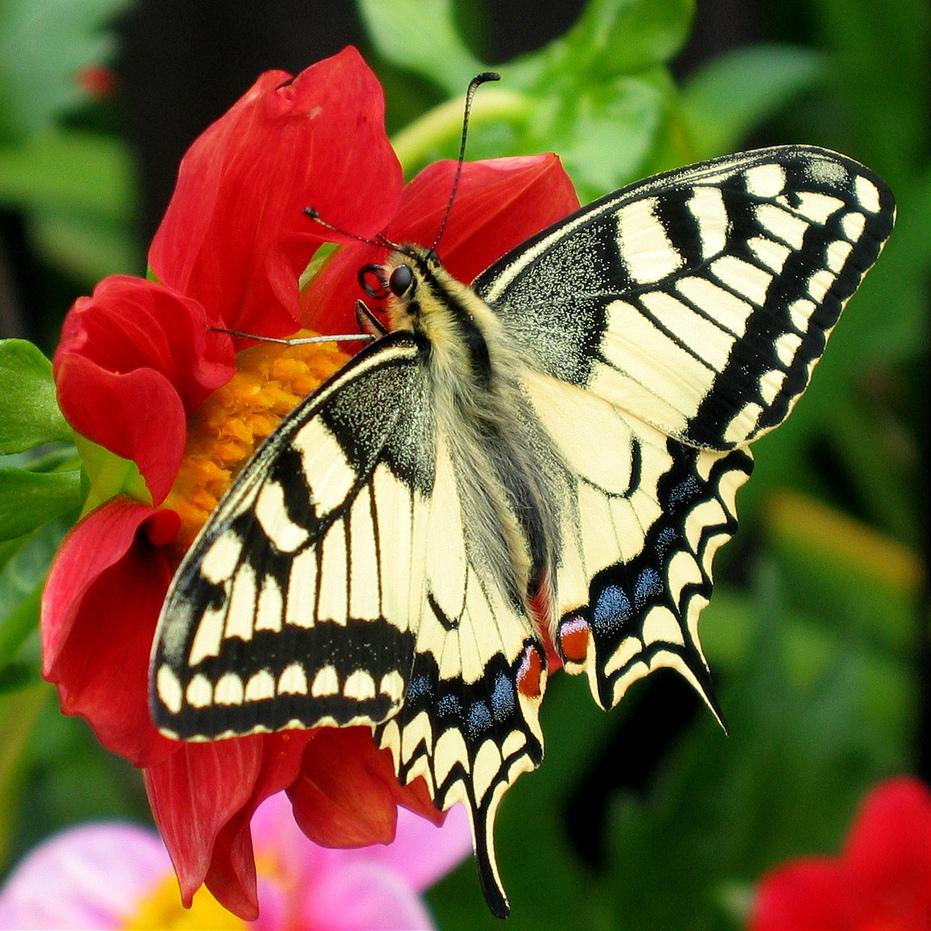
Photo via Wikimedia Commons
The butterfly's metamorphosis is one of the most famous biological processes in nature and one of the least understood in its details. What actually happens inside a chrysalis is more extreme than the popular version suggests: the caterpillar largely liquefies, its tissues dissolve into cellular soup, and from that soup an entirely differently organized body assembles. Whether anything of the caterpillar's experience persists through this is a genuine scientific question with surprising evidence on one side.
Facts you didn't know
- 1
Inside the chrysalis, most of the caterpillar's tissue dissolves. 'Imaginal discs' — clusters of cells dormant throughout larval life — use this raw material to build the adult body essentially from scratch.
- 2
Despite near-total dissolution, butterflies can retain conditioned responses learned as caterpillars. Caterpillars trained to avoid a specific odor emerged as adults still avoiding that odor — suggesting some form of neural memory survives metamorphosis.
- 3
Many of the most vivid butterfly blues and greens are structural colors — produced by nanoscale architecture in wing scales that selectively reflects specific wavelengths. The morpho butterfly's metallic blue exists only as an optical effect. The wing itself contains no blue pigment whatsoever.
- 4
Monarch butterflies navigate from Canada to a specific forest in Mexico they've never visited, using a time-compensated sun compass that corrects for the sun's position changing throughout the day using an internal circadian clock. Individual monarchs have never made this migration before, yet hit the same trees their great-grandparents used.
- 5
Some butterfly caterpillars are fully carnivorous — harvester butterfly larvae eat woolly aphids, and several tropical species prey on ant grubs inside ant colonies, protected by chemical mimicry that makes them smell like ants.