Barreleye Fish
A fish with a completely transparent skull and eyes that look straight up through its own head
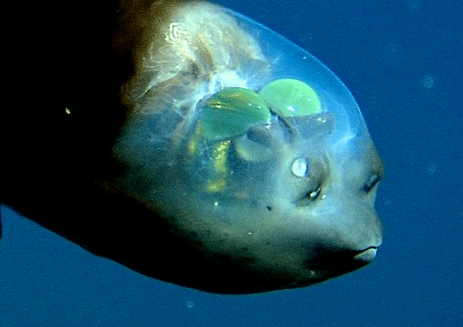
Photo via Wikimedia Commons
Superpower
The barreleye's head is a transparent, fluid-filled dome. Inside it are two barrel-shaped eyes — which rotate from pointing upward (to spot prey silhouetted against the faint surface light above) to pointing forward (to track prey as it eats). For decades, scientists thought the two green blobs at the front of the face were its eyes. They are actually its nostrils. The real eyes are the two green cylinders inside the dome — invisible in dead specimens because the dome collapses under pressure change when the fish is brought to the surface.
Overview
Macropinna microstoma lives in the ocean's twilight zone at 600–800m depth, where sunlight barely penetrates. The anatomy confusion persisted until 2009, when a MBARI submersible filmed a living specimen with dome intact for the first time. The fish appears to steal food from the stinging tentacles of siphonophores, using its transparent dome as protection from the stingers. It spends long periods nearly motionless, slowly rotating those green eyes upward, waiting for the shadow of a small crustacean or worm to pass overhead — then strikes.
Found in
Pacific Ocean from the Bering Sea to Japan and Baja California, at depths of 400–2,500m. Most common around 600–800m in the mesopelagic (twilight) zone.
Things worth knowing
- 1
Every specimen collected before 2009 had the transparent dome crushed by the pressure change during retrieval. Scientists studied this fish for nearly a century without understanding its most defining feature.
- 2
The green color of the eyes comes from a yellow pigment that filters out downwelling sunlight while enhancing sensitivity to bioluminescent flashes from below — giving the fish private-frequency vision.
- 3
The barreleye appears to associate specifically with siphonophores, stealing the small animals caught in the siphonophore's stinging tentacles while using the dome for protection. The siphonophore cannot sting through the dome.
- 4
The fish is tiny — about 15cm — despite the enormous evolutionary investment in its extraordinary sensory apparatus.
- 5
When the eyes point straight forward, the fish's face has an expression that looks disconcertingly like a small, puzzled human face staring at the camera.