Dragonfish
A deep-sea predator with invisible teeth and a private flashlight no other animal can see
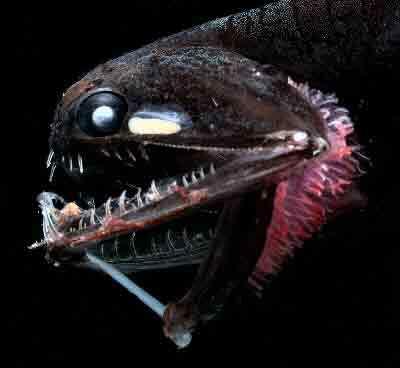
Photo via Wikimedia Commons
Superpower
Deep-sea dragonfish (Stomiidae) have two extraordinary features working together. First, their teeth are made entirely of transparent nanocrystalline material that doesn't scatter light — making the jaws effectively invisible to prey in the dark. Second, they produce far-red bioluminescence at wavelengths (around 705nm) that are invisible to almost all other deep-sea animals, whose eyes lack the pigment needed to detect it. The dragonfish has evolved a rare photopigment allowing it to see its own light. It hunts using a private flashlight in a world of blind animals.
Overview
The dragonfish family (Stomiidae) comprises about 300 species of deep-sea predators found in oceanic midwaters worldwide. They are small — most under 30cm — but ferocious, with enormous fanged jaws relative to body size. The transparent teeth were only described by science in 2020, when researchers examined them under electron microscopes and found a nanocrystalline structure that minimizes light scattering. Most dragonfish also have a bioluminescent lure on their chin (a photophore on a barbel) to attract prey — then illuminate them with their private-frequency searchlight.
Found in
Mesopelagic and bathypelagic zones of all major oceans, typically at depths of 200–1,500m. Most abundant in tropical and temperate waters. Difficult to observe; most specimens collected from deep-sea trawls.
Things worth knowing
- 1
The transparent teeth were described scientifically in 2020. The research team found a nanostructure of hydroxyapatite crystals arranged to minimize the scattering of photons — essentially engineering optical transparency in a solid biological material.
- 2
Most bioluminescent deep-sea animals can only see blue and green light. The dragonfish's far-red illumination exploits a blind spot shared by nearly every other organism at depth.
- 3
Dragonfish have extremely large eyes relative to their body — maximizing light capture in an environment with almost no photons — and multiple layers of photoreceptors to detect the faintest signals.
- 4
Some dragonfish species have stomachs that stretch to accommodate prey nearly as large as themselves — the black dragonfish (Idiacanthus atlanticus) can swallow a fish nearly its own length.
- 5
The female black dragonfish looks completely different from the male — so different that males and females were classified as separate species for decades before the connection was made.