Goblin Shark
A living fossil that fires its entire jaw forward like a slingshot
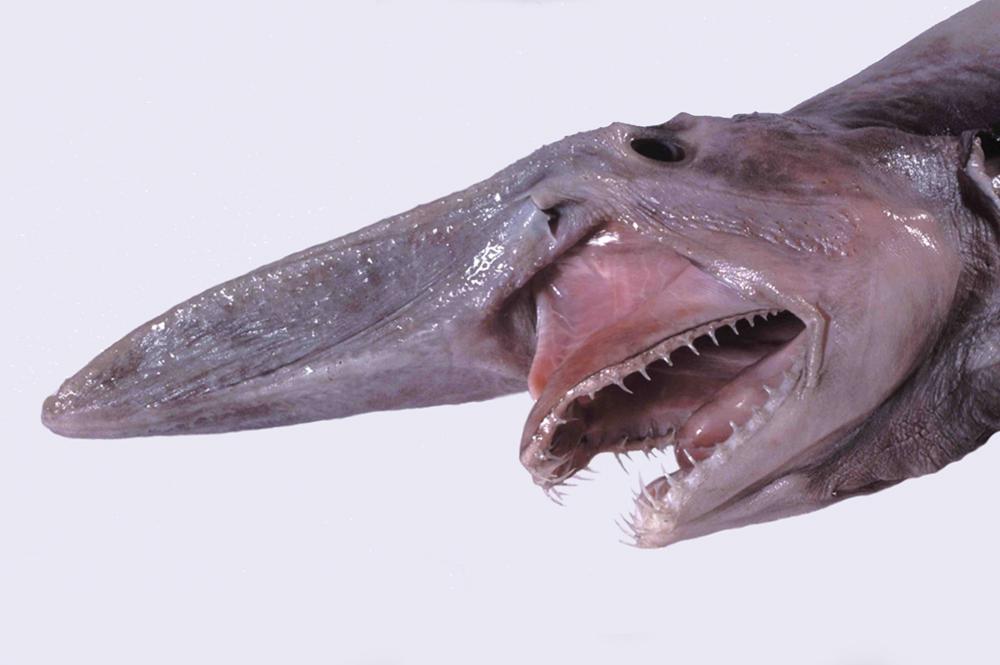
By Dianne Bray / Museum Victoria — fishesofaustralia.net.au, CC BY 3.0 AU
Superpower
The goblin shark's jaw can projectile-launch forward at speed — extending nearly to the tip of its long flat rostrum — to close the gap to prey that its slow swimming cannot. Both the upper and lower jaws fire simultaneously, unlike other sharks, which primarily extend only the lower jaw. Combined with electroreceptors packed into the rostrum to detect the faint electrical fields of hidden prey, this gives it an effective strike range that far exceeds its body mobility.
Overview
Mitsukurina owstoni is the sole surviving member of the family Mitsukurinidae — a lineage extending back 125 million years, making it older than Tyrannosaurus rex. Fewer than 50 living specimens have ever been observed by researchers. Its pale pink coloration is not pigmentation but blood visible through nearly transparent skin — it has almost no melanin. The flabby, low-density flesh and sluggish metabolism suit an environment where encounters with prey are rare and chasing is not an option. When it does strike, the jaw mechanism does the work the body can't.
Found in
Deep oceanic waters globally, mostly below 200m, with specimens recorded as deep as 1,300m. Found in the Atlantic, Pacific, and Indian Oceans. Most commonly caught as bycatch in deep-sea fisheries off Japan, Portugal, and South Africa.
Things worth knowing
- 1
A goblin shark was accidentally caught alive in a Tokyo aquarium intake pipe in 2007 and survived for a week in a tank — the only specimen ever successfully kept alive. Researchers filmed it and documented behavior never previously observed.
- 2
The elongated flat rostrum is not a weapon — it contains ampullae of Lorenzini, electrosensory organs that detect the faint electrical fields emitted by living animals hiding in sediment or in complete darkness.
- 3
Goblin shark teeth vary by position: needle-like at the front for seizing slippery fish; broader crushing teeth at the back for hard-shelled prey. The mix suggests a diet as opportunistic as its environment.
- 4
The pink color of a freshly caught goblin shark fades rapidly to gray-white after death, as blood drains from the vessels visible through the skin.
- 5
Because they are so rarely captured, almost everything known about their biology comes from dead or dying bycatch specimens. Their reproduction, lifespan, and social behavior are almost entirely unknown.