Lyrebird
The world's most accurate vocal mimic — which has been recorded copying chainsaws, camera shutters, crying babies, and car alarms
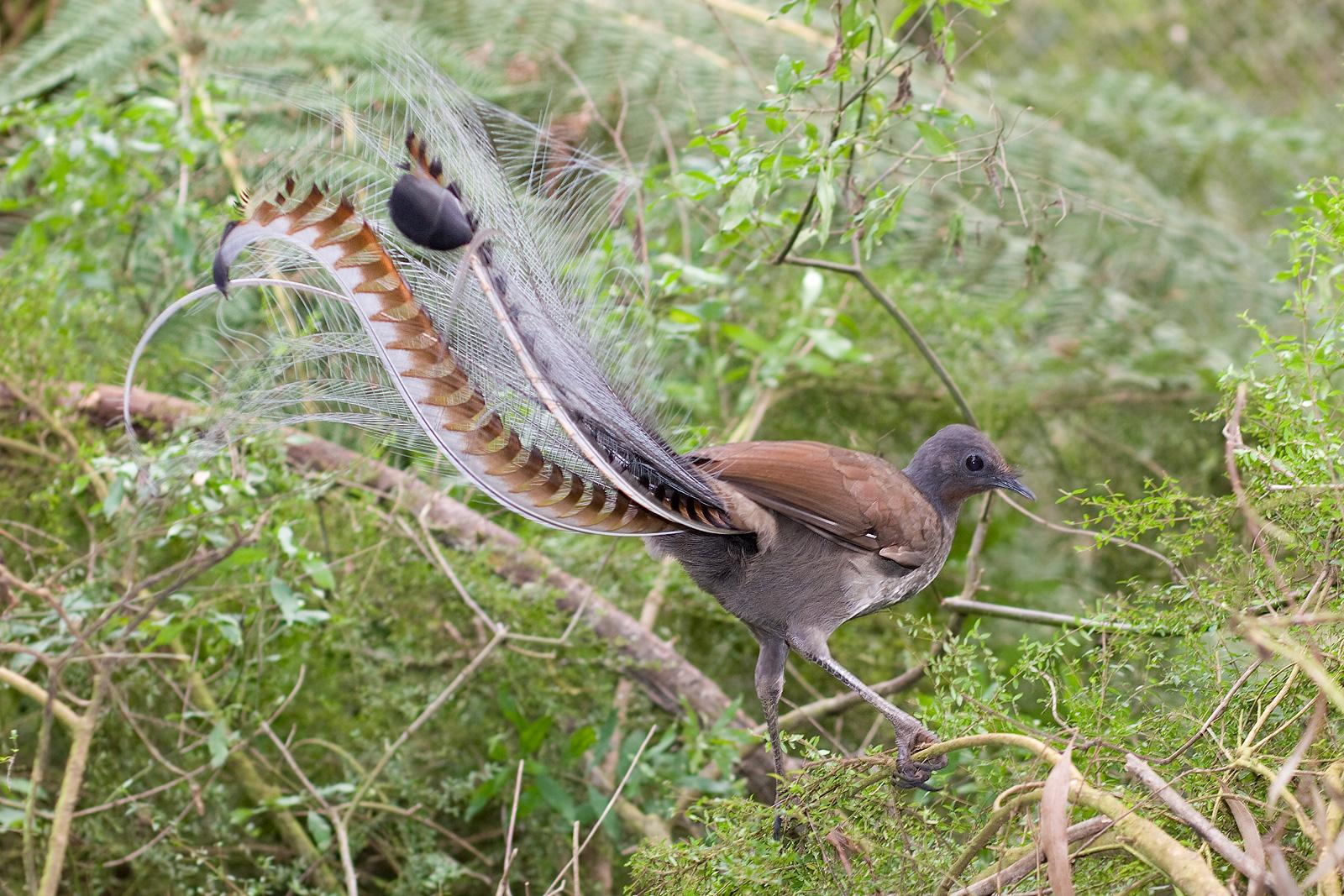
Photo via Wikimedia Commons
Superpower
Superb lyrebirds (Menura novaehollandiae) are the most accurate vocal mimics of any bird — capable of reproducing any sound in their acoustic environment with near-perfect fidelity. Their syrinx (vocal organ) is more complex than any other songbird's, allowing simultaneous multi-frequency production that other birds cannot achieve. They integrate mimicry into their own song seamlessly — a single lyrebird performance typically contains dozens of other species' calls woven together with original vocalizations, chainsaw sounds, camera shutters, car alarms, dog barks, and human voices.
Overview
Lyrebirds are large ground-dwelling birds found in the rainforests of southeastern Australia. Males maintain display mounds and perform for up to four hours daily during breeding season, constructing elaborate song-and-dance performances to attract females. The mimicry serves a dual purpose: it demonstrates the male's experience and memory (older males with more complex, accurate mimicry attract more females) and may provide information to listening females about the sound environment the male inhabits. Lyrebirds have been recording their acoustic environment for thousands of years — researchers believe some lyrebird populations still reproduce calls from sounds no longer present in their habitat, passing them down through generations.
Found in
Rainforests and wet sclerophyll forests of southeastern Australia — Victoria, New South Wales, and southeastern Queensland. Introduced to Tasmania in the 1930s. Rarely seen but commonly heard in appropriate habitat.
Things worth knowing
- 1
Lyrebirds have been documented accurately reproducing human-made sounds including chainsaws, camera motor drives, car alarms, crying children, music, and partial human speech — capturing these in the wild from ambient exposure, not training.
- 2
A lyrebird in Healesville Sanctuary, Australia, named 'Chook' learned to reproduce the sounds of construction occurring near his enclosure in the 1960s — including hammers, saws, and drills. After construction stopped, he continued reproducing those sounds for decades.
- 3
Some researchers have proposed that lyrebird populations in forests that experienced heavy logging retain chainsaw sounds in their cultural repertoire — passing them down through social learning to birds born after the logging ended, preserving an acoustic memory of an event.
- 4
Male lyrebirds build and maintain multiple display mounds in their territory and move between them during display season — dancing on each mound, incorporating leaf-scattering and wing-spreading alongside the song.
- 5
Female lyrebirds also mimic, but less elaborately than males — they appear to use mimicry primarily for alarm calls, reproducing the mob-alarm calls of many species simultaneously to create a 'many-species alert' that causes other birds and animals to scatter.