Vampire Squid
Neither squid nor octopus — a 300-million-year-old lineage that feeds on drifting marine snow instead of hunting
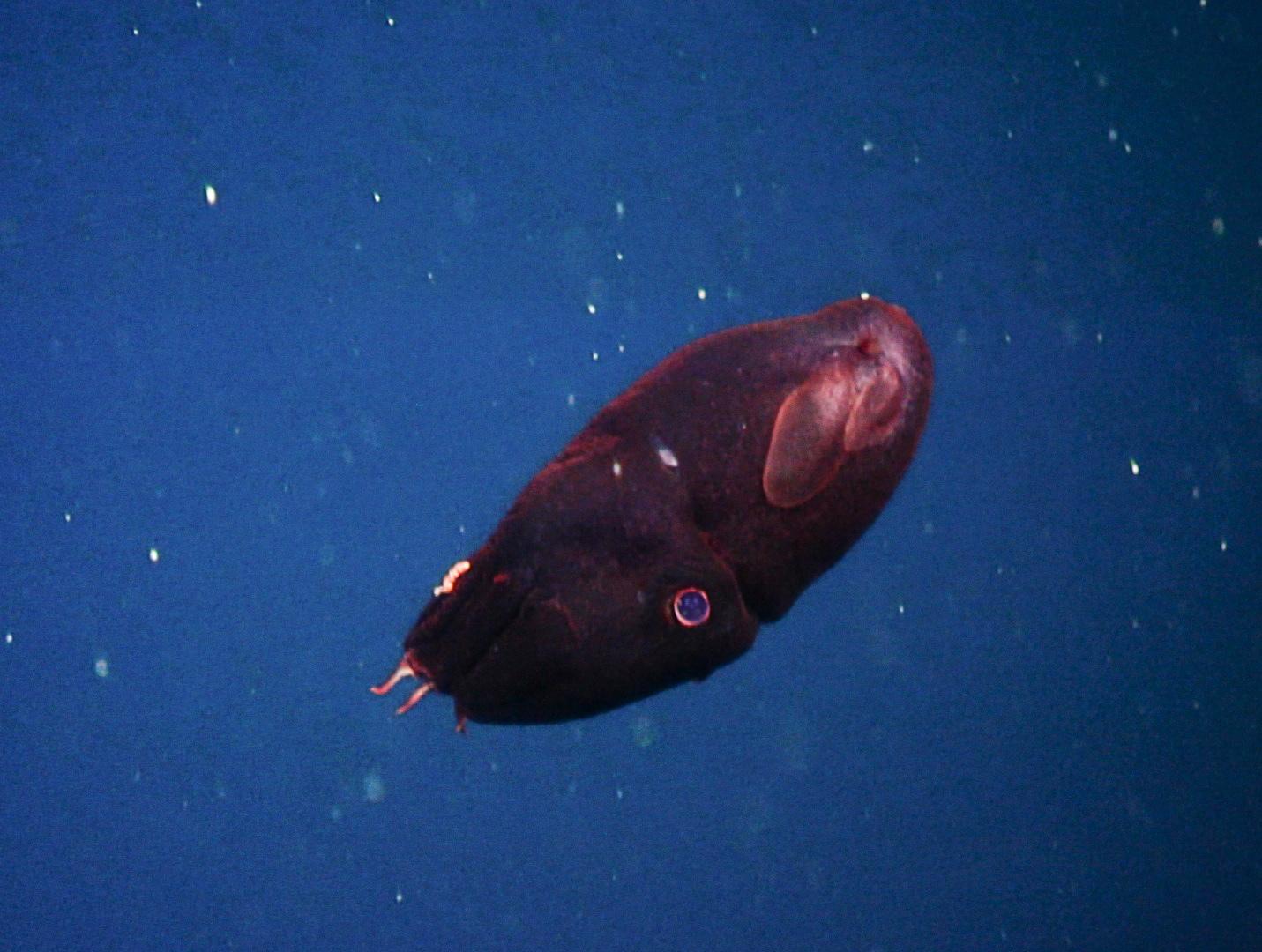
Photo via Wikimedia Commons
Superpower
The vampire squid (Vampyroteuthis infernalis) has two retractile filaments that extend up to 8 times its body length to passively collect marine snow — the constant rain of dead organic matter, fecal pellets, and mucus aggregates falling from above. It is the only cephalopod known to feed this way, having abandoned active hunting entirely. When threatened it inverts its cloak-like webbing over its body, hiding its arms and displaying a spiny bioluminescent exterior.
Overview
Vampyroteuthis infernalis is the sole member of its own order — neither octopus nor squid but something older, diverged from both lineages 300 million years ago. It lives in the oxygen minimum zone at 600–900 meters depth where oxygen levels are so low that most animals cannot survive. Instead of hunting (which requires oxygen), it feeds passively. Its blood uses hemocyanin that functions more efficiently in low-oxygen environments. It has the largest eyes relative to body size of any animal — maximized to detect the faintest bioluminescent flashes.
Found in
Oxygen minimum zones of tropical and subtropical oceans worldwide at depths of 600–900m. Found in all major ocean basins.
Things worth knowing
- 1
Vampire squid produce bioluminescence from photophores covering their body and from two light-producing organs near their eyes — they can control the brightness and duration of each source independently, creating flickering displays that confuse predators.
- 2
Living in the oxygen minimum zone means vampire squid coexist with almost no predators — the same conditions that make the zone unlivable for most animals also protect them, allowing unusual longevity for a cephalopod.
- 3
The vampire squid's name (infernalis means 'from hell') was given by its 1903 describer due to its dark coloration and the red eyes of preserved specimens. Living individuals have blue eyes.
- 4
Unlike true octopuses and squids, vampire squid cannot change color for camouflage — their defense is the cloak inversion and bioluminescent confusion, not chromatic adaptation.
- 5
Their filament feeding strategy means they are almost completely decoupled from the rest of the food web — they don't compete with other predators and are not prey for most hunters at their depth.